
 24
Jul, 2025
24
Jul, 2025
Must Attend Festivals in Arunachal Pradesh More Than Just Celebration
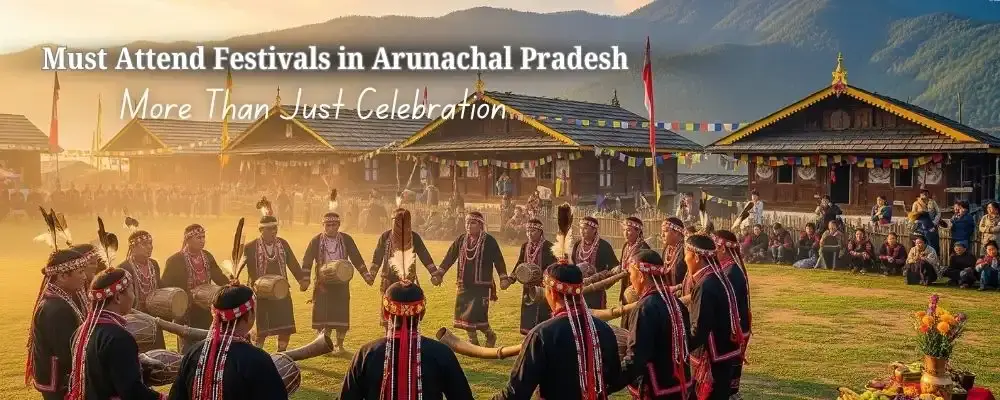
Tell us honestly – what is the first thing that comes in your mind when you think about Arunachal Pradesh – beautiful valleys, mountains, local food – well! You’re almost half right! But what you are missing, my friend, is not the physical beauty but the people of Arunachal and their festivals, which are truly the soul of the state.
Every festival here is a lifetime celebration. Be it praying for a good harvest, or praying to ancestral spirits, or to nature, people here celebrate festivals with joy and together as a community. They dance, feast and enjoy together every moment. What makes Arunachal’s festivals even more special is that once you join in their festival, you also become a part of it.
Let’s go through must-attend festivals of Arunachal with us.
1. Losar Festival – Marking the Tibetan New Year
Celebrated mainly by the Monpa tribe in Tawang and nearby Monpa areas, Losar takes place in the months of February or March (depending upon the lunar calendar). The Losar festival marks the Tibetan New Year and is all about welcoming good vibes, peace and prosperity.
What to expect during the Losar festival – Homes are cleaned up and decorated with new items, as it is believed to be a time to cleanse away the negativity; monasteries are lit up with butter lamps; the air is literally filled with the scent of incense; and the mesmerising Cham dances are performed by monks with masks and costumes.
Tips for visitors – February is super cold here. Take warm clothes and layers. At the same time, don’t forget to dress up modestly while visiting monasteries. Secondly, always take permission before taking pictures, especially in monasteries. Thirdly, don’t forget to try their local homemade food like thukpa, momos, and chang (local barley beer). Lastly, try to reach 2-3 days early and take accommodation near the monastery.
2. Solung Festival – Agricultural Festival of Arunachal
Next is the most important agricultural festival of Arunachal. Solung is celebrated by the Adi Tribe in the Siang district and nearby areas in the month of monsoon, usually in the first week of September. The celebrations last for about 5 days, each day having its own ritual and importance.
What to expect during the Solung festival – Mithuns and pigs are sacrificed to appease deities as a part of a ritual to seek prosperity. Women in traditional attire sing folk songs that speak about the creation story of the Adi tribe and perform the Ponung Dance in a circle.
Tips for visitors – Be respectful towards their rituals. If you ever get lucky to be invited by a local, don’t say no! You must try their local community drink, Apong, which is the rice beer that truly brings everyone together.
3. Nyokum Yullo – The festival for harmony
Nyokum Yalla is celebrated on 26th February by Nyishi Tribes where the whole community comes together to please the deities of nature.
What to expect in Nyokum Yullo festival – Celebration usually takes place in open fields wherein people dressed up in traditional Nyishi attire (yes, with that famous feathered headgear) dance, feast together, and chant prayers. No idols are worshipped. Instead, there’s a symbolic altar called the Yugyang.
Tips for visitors – If your get chance to be invited by locals, then do try their local cuisines during the community feast. Guests are openly welcomed with rice paste powder and opo. Respect the customs. Always ask before taking pictures.
4. Dree Festival,
Next is another agricultural festival in Arunachal Pradesh is the Dree Festival, celebrated each year on the 5th of July by the Apatani tribe. Their community offers prayers to four gods – Tamu, Metii, Mepolyang, and Danyi – who are believed to protect crops and ensure the fertility of the land.
What to expect in Dree Festival – The festival begins with priests (shamans) chanting hymns and then performing traditional rituals like sacrificing the fowls. Locals dress in their best traditional attire with silver jewellery. The celebration continues the next day when locals come together to enjoy a community feast where everyone cooks together. Then, they even perform the famous Apatani folk dance ‘Daminda.
Tips for visitors – Ziro Valley is the perfect place to be if you want to experience the Dree festival. Arrive a few days early if you want to see the preparations and actually enjoy the festival like locals do. Try their local cuisine – pika pila (a bamboo shoot pickle), bamboo chicken, and rice wrapped in leaves.
5. Sangken Festival – Water festival of Arunachal
Imagine monks chanting prayers collectively, and suddenly a splash of scented water comes in on you, and you will find everyone splashing water on each other. That’s Sangken! Sangken marks the beginning of Buddhist new year, based on a belief that water will wash away the negativity and bad karma of the past year. The festival usually falls in mid April and is mainly celebrated in Namsai, Chongkham, and other Khamti areas.
What to expect in the Sangken Festival - Rituals starts with monks chanting hymns and gently bathing Buddha statues in scented water. Locals set up a temporary bamboo temple known as "Kyongfra" where they place the image of Buddha. Then comes the fun part! Everyone starts splashing water on each other. Don’t mistake it with Holi; here the intention is more to cleanse the negativity and bad karmas.
Tips for visitors – Don’t forget to carry an extra pair of clothes during the festival. Be respectful towards monks during prayer times. Do not splash water at that time. Say "Sangken Poi Mai!" (Happy Sangken!) with a smile.
Other Notable Festivals –
- Mopin – Welcoming Abundance in April
- Boori Boot Yullo – Celebrated in the Upper Subansiri district
- Loku Festival – Of the Nocte tribe in Tirap; marks end of winter
- Reh Festival – Dance, Myth, and Magic
The festivals of Arunachal are literally the soul of the state. If you will ever visit or plan to visit during these festivals, try to be a part of these events. If you need our help in planning your travel to Arunachal, then contact us at 9667064818.
-
Best Places To Visit In December In India
13 Oct, 2026 -
Best Corporate Outing Places Near Delhi 2026
05 Dec, 2025 -
Must Attend Festivals in Arunachal Pradesh More Than Just Celebration
24 Jul, 2025 -
Best Time To Visit Switzerland A Desi Guide For Indian Traveller
05 Jun, 2025 -
10 Cheapest European Countries to Visit from India
09 Apr, 2025 -
Top 10 Cheapest Countries To Travel From India In 2025
19 Mar, 2025 -
Top Places to go for Valentines Day in India
08 Feb, 2023